


Pinnacle Safety and Training does not offer Recognition of Prior Learning (RPL) for this course. Due to the duration and cost of this short course, RPL assessment would have limited value to participants.
Students who are deemed competent will receive a Statement of Attainment recognised under the Australian Qualifications Framework. This certification is nationally recognised. The Statement is issued by Pinnacle Safety and Training (RTO 40496).
National units of competency
- RIIWHS202E - Enter and work in confined spaces
- MSMWHS217 - Gas test atmospheres
- MSMPER300 - Issue work permits
- MSMWHS201 - Conduct hazard analysis
- MSMPER200 - Work in accordance with an issued permit
Course duration: 2 days (approximately 8 hours per day)
Up to 12 trainees per course
- $449.00 pp for public courses
- For group bookings outside our public course schedule or at your location, please submit your group booking enquiry here for an obligation free quote.
- $499.00 pp for public courses
- For group bookings outside our public course schedule or at your location, please submit your group booking enquiry here for an obligation free quote.
- $489.00 pp for public courses
- For group bookings outside our public course schedule or at your location, please submit your group booking enquiry here for an obligation free quote.
- Brisbane: $499.00 pp for public courses
- Gold Coast: special price $438.00 pp for public courses
- For group bookings outside our public course schedule or at your location, please submit your group booking enquiry here for an obligation free quote.
- $438.00 pp for public courses
- For group bookings outside our public course schedule or at your location, please submit your group booking enquiry here for an obligation free quote.
“Should I do the 1 day course or this 2 day course?”
Our Confined Space Entry 2 day course is for:
- Anyone who wants a greater depth of knowledge of working in confined spaces
- Anyone with a hands-on role in the hazard analysis and risk assessment aspects of confined space operations
- Anyone who may have to act in the role of standby person
- Anyone who wants to be able to issue confined space work permits
- Anyone who may need to supervise other workers during confined space operations.
This course covers everything from our regular Confined Space Entry 1 day course, with an extra day for the content and practical activities relating to roles and responsibilities of the team, hazard analysis, and the confined space permit issuing process.
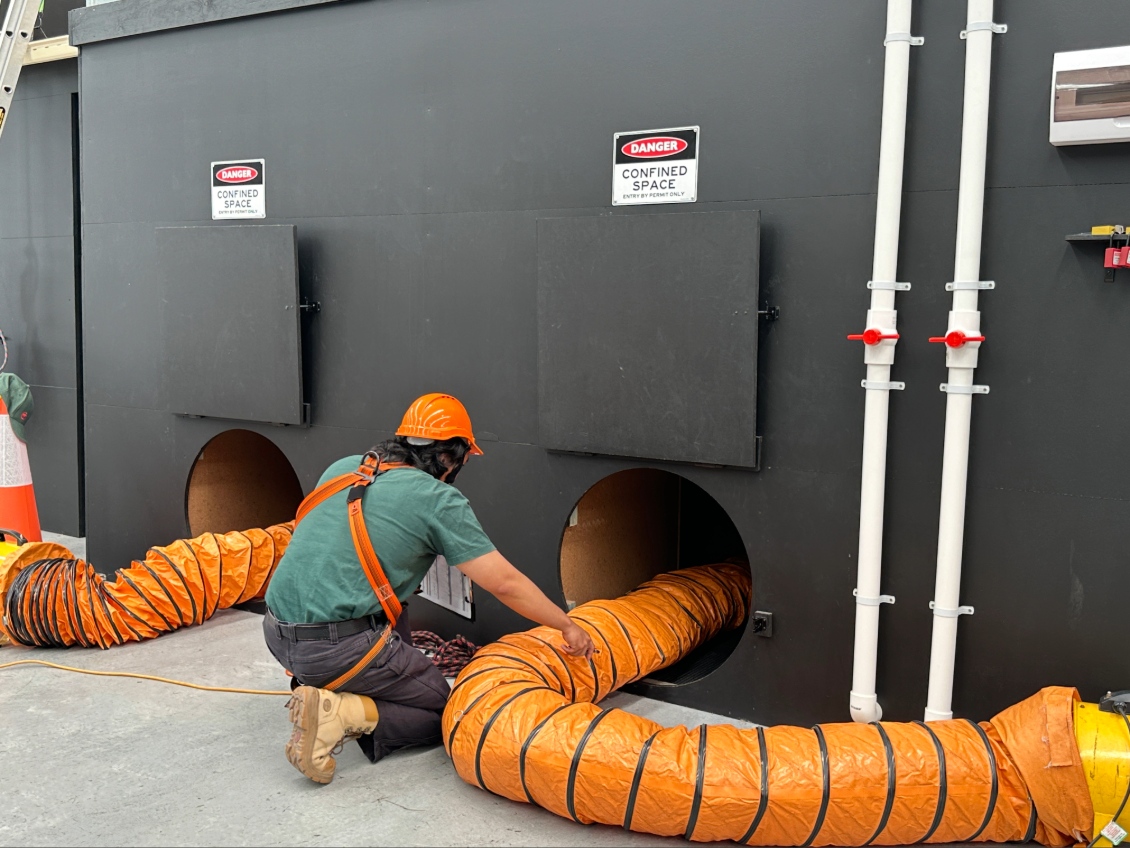
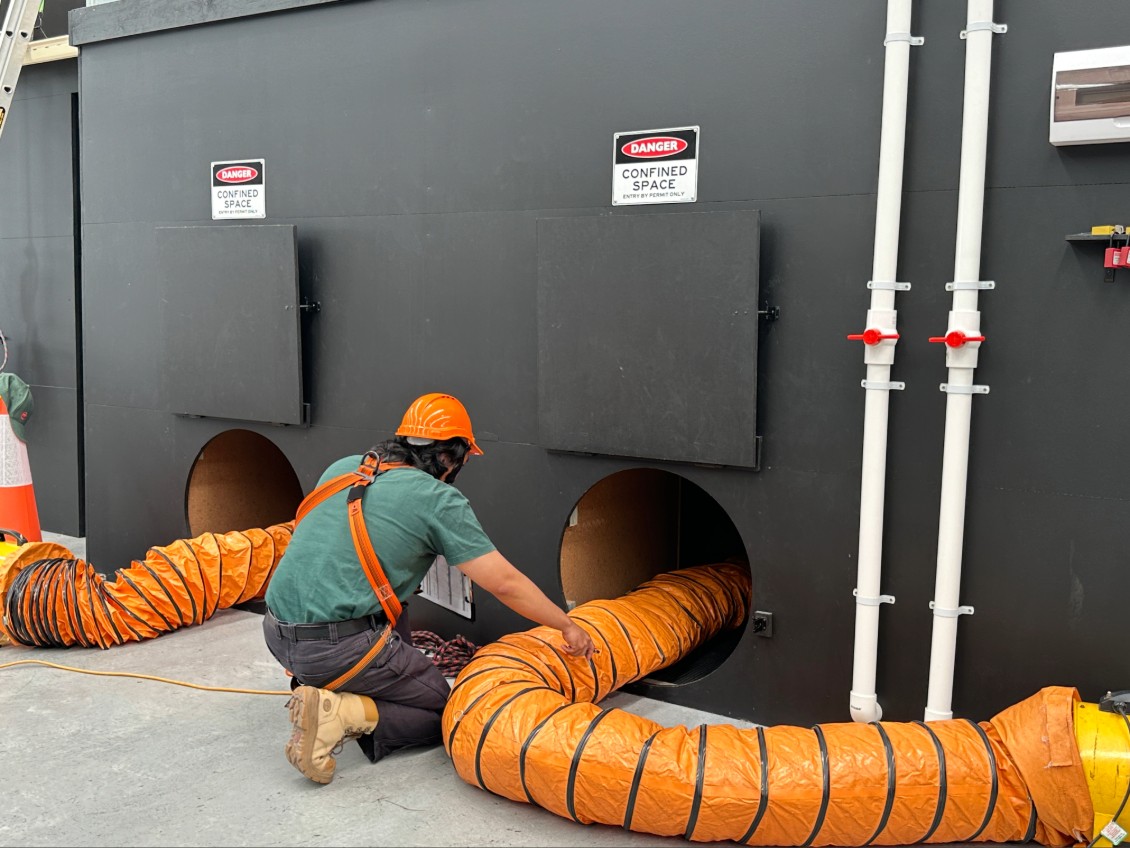
This nationally recognised training course is designed for people who work in or around confined spaces. The course can be tailored to suit your company’s specific training requirements focusing on the safety procedures and practical scenarios relevant to your particular confined space operations. While there is a standard set of learning outcomes for the course, we understand that the context and environment in which the learning is applied is varied. It is designed to teach participants how to:
- Identify and control confined space hazards
- Work safely within confined spaces
- Review and assess a range of confined space permit applications
- Issue entry permits for confined space operations
- Undertake gas testing procedures and interpret readings
- Monitor compliance with issued confined space permits
- Address and report non-compliances with permit conditions
If you need to be able to operate breathing apparatus, please see our Operate Breathing Apparatus course.
Likewise, if you need to be able to undertake confined space rescue, please see our Confined Space Rescue course.
According to the Safe Work Australia Code of Practice, a “confined space” means an enclosed or partially enclosed space that:
- is not designed or intended primarily to be occupied by a person; and
- is, or is designed or intended to be, at normal atmospheric pressure while any person is in the space; and
is or is likely to be a risk to health and safety from:
- an atmosphere that does not have a safe oxygen level, or
- contaminants, including airborne gases, vapours and dusts, that may cause injury from fire or explosion, or
- harmful concentrations of any airborne contaminants, or
- engulfment.
Examples of confined spaces include (but are not limited to):
- Storage tanks
- Tank cars
- Process vessels
- Pressure vessels
- Boilers
- Silos and other tank-like compartments
- Pits and degreasers
- Pipes
- Sewers
- Sewer pump stations including wet and dry wells, shafts and ducts
- Shipboard spaces entered through small hatchways or access points, cargo tanks, cellular double bottom tanks, duct keels, ballast or oil tanks and void spaces.
- Confined space supervisors
- Regular confined space workers
- Electrical engineers
- Safety inspectors
- Safety personnel
- Injury prevention personnel
- Maintenance personnel
- Emergency services personnel (fire, ambulance, police)
- WHS officers
- Risk managers
- Mine managers
- Telecommunications and cable installation personnel
- Lift operators and installers
- Transport industry workers
- Utility industry workers.
- Identifying confined spaces
- OHS legislation, Compliance Codes and Australian Standards relevant to confined spaces
- Roles and responsibilities of management and employees
- Hazard identification, risk assessments and hierarchy of controls
- Issuance of confined space permits
- Work site policy and procedures
- Isolation procedures
- Atmospheric monitoring and gas detection
- Working at height and fall protection equipment
- Safety and emergency procedures
- Practical entry into a confined space
Australian Standard AS2865 recommends refreshing confined space training every 12-24 months.
- Two 8 hour days of face-to-face training conducted by an experienced confined space specialist
- Hands-on practical training designed to develop safe work practices
- Knowledge of relevant legislation, codes of practice and Australian Standards relevant to confined spaces
- Recommendations and advice for specialised PPE and equipment for your workplace
- Advice on risk control methods for the type of work to be undertaken
Participants must
- Be at least 18 years of age
- Wear suitable attire (including long pants and closed-in shoes)
- Provide their own lunch and transport
- Have a sufficient level of reading, writing, numeracy and oral communication to undertake this training, including the ability to:
- read and interpret documentation relevant to the confined space entry permits
- write clearly in English to complete workplace forms
- speak clearly and understand verbal communication in English
- understand gas concentration measurements and interpret gas testing results
- explain and respond to a range of workplace scenarios
Equipment
- We supply all equipment necessary for you to undertake training, however we actively encourage you to bring along your own equipment.
Lorem ipsum dolor sit amet, consectetur adipiscing elit. Suspendisse id eros justo. Vivamus tincidunt auctor elit, non scelerisque urna tincidunt non. Ut suscipit sapien ut nisi maximus, a fermentum magna aliquam. Fusce non posuere nulla. Integer id nunc ultricies, fermentum mi sit amet, feugiat nunc. Nunc auctor, metus sed efficitur ullamcorper, libero sem vulputate nulla, vel aliquam purus erat non velit.
Lorem ipsum dolor sit amet, consectetur adipiscing elit. Nulla ac ante quis felis blandit tempor. Quisque sit amet dolor turpis. Curabitur auctor quam non magna venenatis, ut tincidunt lectus lacinia. Morbi venenatis magna et felis facilisis, id sollicitudin nulla ultricies. Sed suscipit dolor vel augue fermentum, sit amet ullamcorper lorem ullamcorper. Sed id felis vel purus tincidunt fringilla ut nec enim.
Lorem ipsum dolor sit amet, consectetur adipiscing elit. Nulla ac ante quis felis blandit tempor. Quisque sit amet dolor turpis. Curabitur auctor quam non magna venenatis, ut tincidunt lectus lacinia. Morbi venenatis magna et felis facilisis, id sollicitudin nulla ultricies. Sed suscipit dolor vel augue fermentum, sit amet ullamcorper lorem ullamcorper. Sed id felis vel purus tincidunt fringilla ut nec enim.
Lorem ipsum dolor sit amet, consectetur adipiscing elit. In vel felis vel felis hendrerit eleifend. Sed euismod augue at gravida fermentum. Vivamus auctor, ante sed dapibus auctor, metus justo malesuada purus, nec fermentum mi augue ac lorem. Nulla facilisi. Integer ac orci felis. Donec et erat id metus varius elementum. Aenean volutpat sapien id risus posuere, sed efficitur dolor tincidunt.
