


Recent fall incidents and upcoming compliance campaigns by industry regulators throughout Australia are timely reminders for businesses to review how they manage working at heights risks, before gaps become incidents.
A recent fatal fall incident in Western Australia is a serious reminder that working at heights risks are not distant possibilities, but present-day realities. WorkSafe WA is investigating a March 2026 incident where a contract night-shift worker was fatally injured while performing maintenance at a mine processing plant. Preliminary information suggests the worker may have fallen through an opening in a grid mesh platform adjacent to his work area.
The incident remains under investigation, and no causative factors have been confirmed. However, for businesses across mining, construction, maintenance, utilities, telecommunications and industrial operations, it raises an important question:
Are your working at heights controls current, effective and actually being followed?
With Workplace Health and Safety Queensland also launching a statewide construction compliance campaign focused on working at heights from July 2026, now is the right time for business owners, HR teams, supervisors and workers to review the controls they rely on.
Eliminate the risk where possible
The safest way to manage a fall risk is to remove the need to work at height in the first place.
Before assigning a task, consider whether the work can be completed from the ground, through improved design, prefabrication, remote access, mechanical aids or another method that removes exposure to a fall hazard.
Elimination is not always possible, but it should always be considered first. Too often, working at heights becomes “just how the job is done” rather than a risk that could potentially be designed out.
Use fall prevention controls
Where working at height cannot be eliminated, fall prevention controls should be prioritised wherever reasonably practicable.
These are controls that stop a worker from being exposed to a fall risk in the first place. Examples include scaffolding, edge protection, guardrails, covered penetrations, secured platforms and elevating work platforms.
These controls are generally stronger because they do not rely solely on the worker’s individual behaviour or personal protective equipment.
For businesses, this means checking that fall prevention controls are suitable for the task, correctly installed, inspected, maintained and clearly understood by the people using them.
Apply work positioning and limited free-fall systems correctly
Where fall prevention is not practicable, work positioning and limited free-fall systems may be required.
Work positioning systems, such as restraint systems, are designed to prevent a worker from reaching an unprotected edge or fall hazard. They rely on correct system design, suitable anchor points, compatible equipment and workers who understand how to adjust and use the system properly.
Limited free-fall systems, such as inertia reels and Lad-Saf systems, are designed to reduce the distance and impact of a fall. These systems need to be selected, installed and used within their design limitations.
Workers also need to understand clearance requirements, swing-fall risks, inspection requirements, and rescue implications. A system that is misunderstood, poorly adjusted or used in the wrong environment can create a false sense of security.
Keep equipment inspection, rescue planning and refresher training current
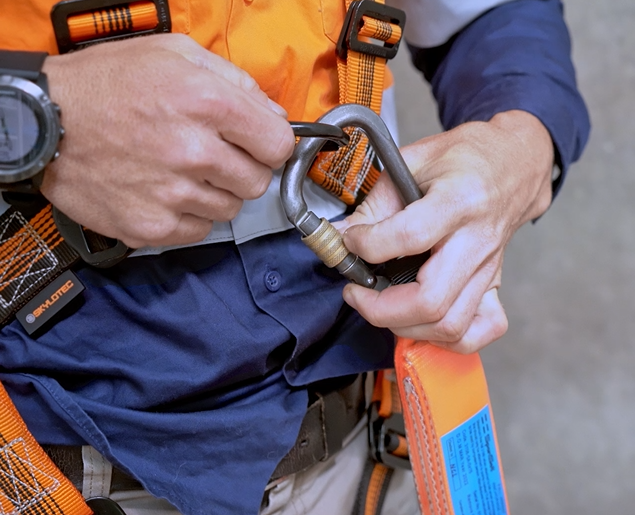
Free fall arrest systems, such as harnesses, anchors and two-metre energy-absorbing lanyards, can be critical controls. But they should never be treated as a simple “clip on and go” solution.
Fall arrest requires careful consideration of fall distance, anchor strength, equipment compatibility, worker competency and rescue planning.
If someone falls and is suspended in a harness, the rescue plan needs to work immediately, not just exist in a folder.
This is where equipment inspection and current training become essential.
Harnesses, lanyards, ladders, anchors, ropes, connectors, inertia reels and other height safety equipment must be fit for purpose. If equipment is worn, damaged, expired, contaminated or questionable, it needs to be tagged out and reported.
Pinnacle’s Height Safety Equipment Inspection course helps businesses build the capability to conduct formal periodic inspections of height safety equipment and identify faults, wear and compliance issues before equipment goes back into service.
Pinnacle also supports businesses with practical height safety training, including:
- Working at Heights
- Vertical Rescue
- Tower Climbing and Rescue
Our Working at Heights training helps workers understand hazards, controls, equipment and safe work requirements.
Vertical Rescue training supports workers who may need to perform rope-based rescues from difficult-to-access locations.
Tower Climbing and Rescue training is designed for workers who climb and perform rescues on towers, poles, chairlifts and similar structures.
The upcoming WHSQ campaign should prompt businesses to review their compliance obligations, including SWMS requirements, fall prevention controls and the management of risks where a person could fall more than two metres.
But strong safety performance goes beyond compliance.
Businesses should be asking:
- Can we eliminate the need to work at height?
- Are we using the highest level of control that is reasonably practicable?
- Are workers and contractors trained, competent and supervised?
- Do our rescue plans work in real site conditions?
- When was the last time our team completed refresher training.
If the answer to any of these questions is unclear, now is the time to act.
Related Articles

Work at Heights Training for over 1,000 Bechtel workers at Yarwun
Pinnacle Height Safety Pty Ltd has successfully delivered nationally accredited work-at-heights training at Yarwun for Bechtel Corporation. Bechtel is a key supplier for major construction projects at...

Work at Heights Training for Woodside Energy
In June 2011, we commenced our Work at Heights training with Woodside Energy on the dive vessels Venturer and 119m Rockwater II.Subsea 7, in association with Technip Oceania, is managing an underwater...
Your Cart
